Best Time to Visit
April-June
September-October
Population
346.625
Airports
Cardak Airport
Best Places to Stay
Karahayit
From a distance, Pamukkale looks almost unreal: a white slope rising beneath the ruins of an ancient city. Up close, the two belong together. Thermal water created the travertines, attracted settlement, and shaped the history of Hierapolis above them.
A short visit may be enough to see the white terraces, though it leaves little time for the Roman and Byzantine city above them. Allow time to walk the permitted travertine sections and continue into Hierapolis.
The sequence becomes important in hot weather. We usually begin with the longer archaeological walk through Hierapolis, then slow the pace on the travertines later in the visit.

Planning a trip to Pamukkale? Answer this trip planner and get your FREE quotation within 24 hours.
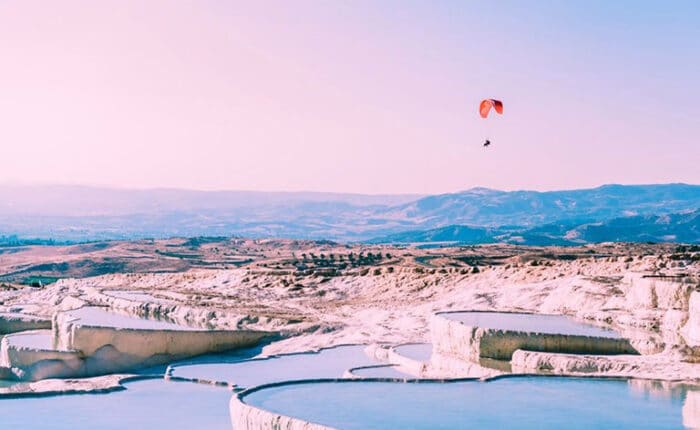
Pamukkale means “cotton castle” in Turkish. Its white terraces formed as calcium-rich thermal water flowed down the hillside, releasing carbon dioxide and leaving calcium carbonate behind. Over thousands of years, those deposits created the pale basins, ridges and flowing contours visible today. Water still shapes the surface, which is why access is carefully managed.
Hierapolis began in the Hellenistic period and flourished under Roman rule. The springs contributed to the city’s importance, but its scale reaches far beyond an ancient spa. The theatre, Necropolis, Frontinus Gate, baths, Plutonium and remains associated with St. Philip reveal a substantial settlement built directly above the thermal landscape.
Three to four hours is a sensible starting point for the travertines and the principal monuments of Hierapolis. Travellers with a strong interest in archaeology can stay considerably longer. Most visitors need no more than one well-planned day.
The site involves a fair amount of walking over uneven ground. In summer, see the principal monuments of Hierapolis before the strongest afternoon heat, then finish at a gentler pace on the travertines. Covering every ruin rarely improves the visit.
A private day trip from Kusadasi or Selcuk leaves enough time for both parts of the site. From farther away, the road begins to take over the day. An overnight stay can restore that balance and may also simplify the following transfer.
Denizli Cardak is the nearest airport. Stay locally if an early or summer-evening visit fits the wider route. When the overnight adds only another hotel change, continuing the journey may be more comfortable.
Pamukkale has three entrances, and the best choice depends on the order of your visit. The South Gate is the practical default for most first-time visitors arriving by private vehicle, as it provides convenient access to the main cluster around the travertines, Ancient Pool, museum and theatre path. The North Gate begins near the Necropolis and suits travellers who want to explore Hierapolis first and are comfortable with a longer archaeological walk.
The town entrance begins below the terraces with a barefoot uphill walk. It can suit travellers staying in Pamukkale village, though the climb feels demanding in summer. If you plan to enter through one gate and leave through another, arrange the vehicle and luggage in advance so the day ends smoothly.
The thermal pool near the ruins is widely known as Cleopatra’s Pool. No direct connection with Cleopatra has been established. Its appeal comes from the warm mineral water and the ancient architectural fragments resting within the pool.
Access has changed during previous work at the site. If swimming matters to you, check the current status shortly before arrival. Build the day around the travertines and Hierapolis, with the pool included if it is operating.
Lockers and changing facilities are normally available around the Ancient Pool complex for a fee. Facilities are less predictable at the other entrances, especially when entering through one gate and leaving through another. Pack lightly and keep valuables in a small water-resistant bag.
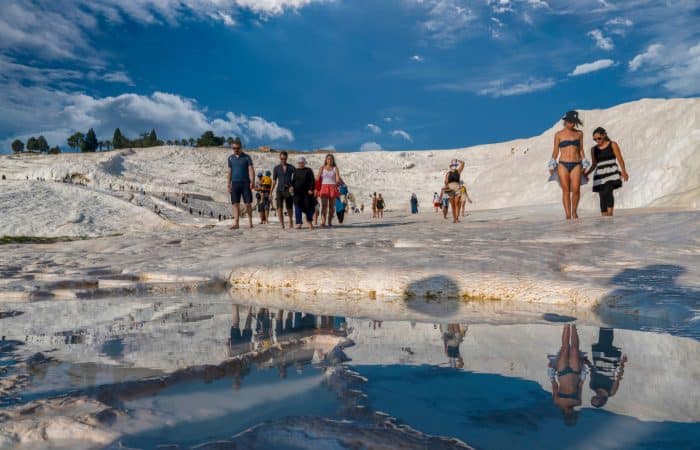
Carry sunglasses, sunscreen and plenty of water, especially during the summer months. Visitors walk barefoot on the permitted travertine sections to protect the formations, but comfortable shoes are still important for Hierapolis and its uneven ground. Choose footwear that is easy to remove and bring a small bag for carrying it across the travertines.
If the Ancient Pool is confirmed open and you plan to swim, bring a swimsuit and towel. Swimming requires a separate payment and remains an addition to the archaeological visit.
Children often enjoy the flowing water on the accessible travertines, but Hierapolis can become tiring in summer. Once they reach the water, persuading them to begin a long archaeological walk can be difficult; the sequence matters as much as the list of monuments.
The theatre, a carefully chosen section of the ancient city and unhurried time on the travertines usually make a better family visit than attempting every monument under the midday sun. An evening visit may reduce the heat, but dinner, children’s sleep and the following morning should be considered before fixing the itinerary.
Early morning and late afternoon are generally more comfortable in summer. The white surface reflects strong light, while the archaeological site offers limited shade. Late-day light also suits the travertines particularly well.
Opening hours and permitted access can vary by season and by entrance. Check the live schedule before deciding whether an early start or later visit works better with the wider itinerary.
For the 2026 season, Hierapolis-Pamukkale is included in Türkiye’s night-museum programme from 1 June to 1 October. Evening access can move much of the archaeological walk out of the hottest part of the day and gives the travertines a different quality as the light softens.
Before choosing an evening visit, check the finishing time against dinner, the hotel location and the following morning’s transfer. A late departure works best when the rest of the itinerary can absorb it comfortably.
Winter offers cooler walking conditions and fewer visitors. Snow occasionally falls, though it cannot be planned around, and the Ancient Pool’s operating status still requires a current check. The season often suits archaeology-focused travellers who value comfortable walking over the summer atmosphere.
Pamukkale has plenty of restaurants serving familiar Turkish and international dishes. The more distinctive regional choice is Denizli kebab: lamb slowly cooked in a stone oven and traditionally served with bread, tomatoes and onions. The established area around Kaleici Bazaar and Bayramyeri Square is a reliable place to seek it out when the route passes through central Denizli.
A full day from Kusadasi or Selcuk already involves substantial driving. Adding central Denizli solely for lunch can reduce time at Hierapolis, so a lighter meal near the site or a planned stop on the onward route may fit the day better.
Travellers staying overnight have more time to explore the regional table. Alongside Denizli kebab, look for Aegean vegetable and olive-oil dishes, locally grown thyme and sage, and semolina helva served with ice cream.
The wet travertine surface can be slippery, with uneven or sharp sections underfoot. Walk slowly, remain on the permitted route and take particular care where the level changes. Closed basins and cliff edges are protected areas, even when they appear to offer a better photograph.
The formations remain active and carefully managed. Visitors walk barefoot only in designated sections, and water does not flow through every open basin at all times. Follow the current signs and staff directions.
Early morning usually brings cooler conditions and a quieter start. The best slot still depends on the season, entrance and onward route. An overnight stay becomes useful when it improves more than crowd levels—especially the walking temperature or the following transfer.
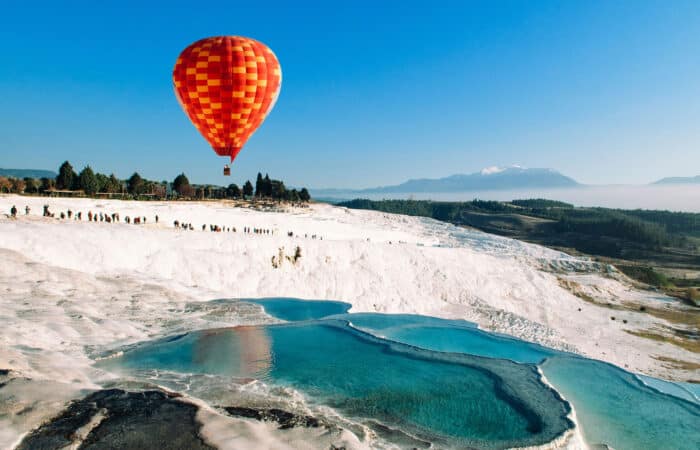
Hot-air balloons also fly over Pamukkale in suitable weather. The view and landscape are entirely different from Cappadocia, giving the flight its own identity. Keep the archaeological day workable in case weather prevents take-off.
Paragliding offers another aerial view of the travertines and surrounding landscape. It is quite different from flying from Babadağ in Oludeniz and works best as an optional extension for travellers who already have enough time for the main Pamukkale visit.
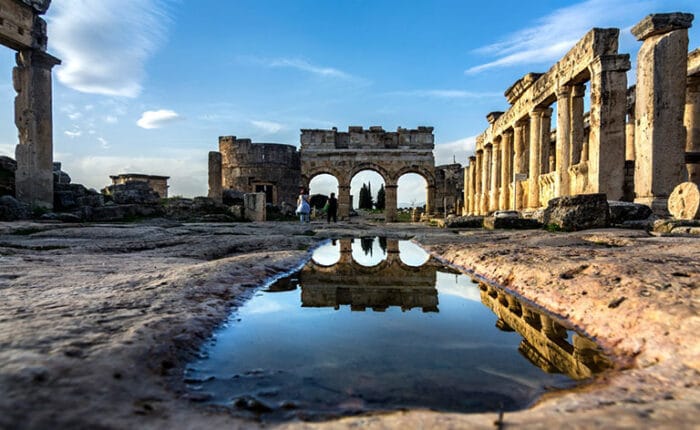
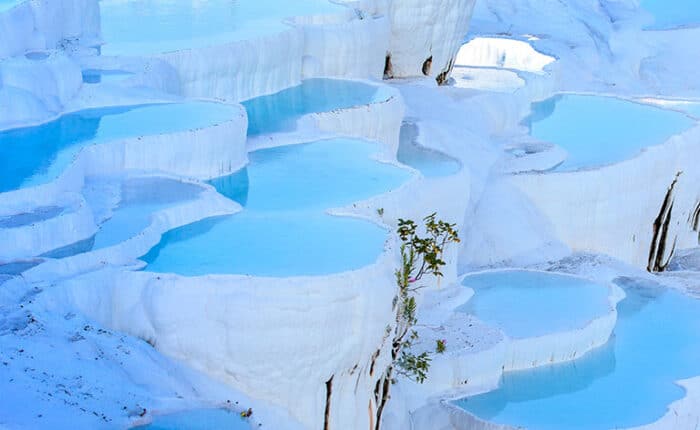
Pamukkale works best when the travertines and Hierapolis are planned as one visit. The theatre, Necropolis, ancient gates and thermal landscape give the day its range; walking briefly across the white terraces shows only one part of the site.
This combination of archaeology and an active thermal landscape explains why Hierapolis and Pamukkale are protected together as a UNESCO World Heritage Site. The tours below allow enough time for both, while fitting the visit into the wider route through western Turkey.
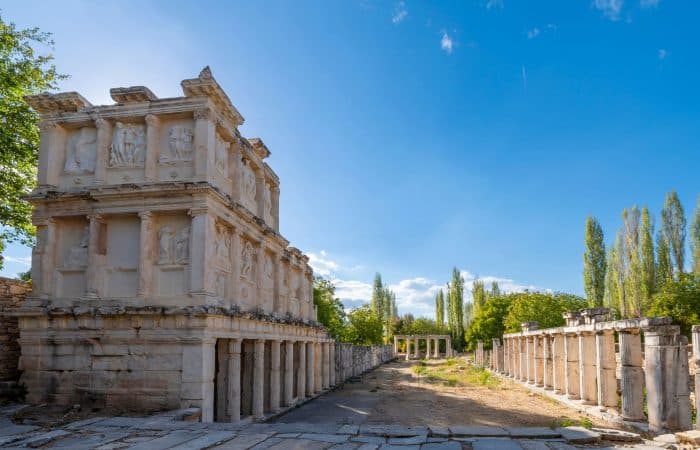
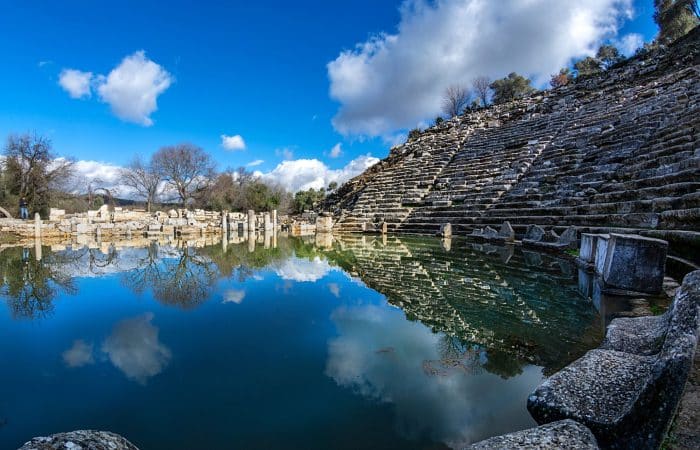
After Ephesus, add Aphrodisias only when daylight and the group’s archaeological interest support another substantial site. Laodicea lies closer to Denizli and often fits the route more easily. Attempting Ephesus, Aphrodisias and Pamukkale in one day reduces all three to a checklist.
For an eastbound journey, Konya can break up the drive to Cappadocia and make for a worthwhile visit of its own. Travelers returning to the coast can naturally connect Pamukkale to the wider Aegean or Mediterranean routes.